
Tsuklakkhang
The Main Temple or Tsuklakkhang (གཙུག་ལག་ཁང་) is the largest structure in the center of the monastic complex and includes the Assembly Hall or Dukhang (འདུ་ཁང་). Its front part, including the original veranda of the Dukhang, has been altered soon after the Dukhang's construction. As the in situ survey with architects from the Graz University of Technology has revealed, these alterations include the addition of flanking buildings and the courtyard in a relatively clear chronological sequence.
Dukhang
The Assembly Hall, or Dukhang (འདུ་ཁང་), comprises three structural units, including a veranda, a main hall measuring 7.5 x 7.9 metres, and a large niche measuring 3.3 x 2.4 metres in the back wall. It is also the oldest monument preserved at Alchi, but there is no conclusive evidence for the time interval between this temple and the Sumtsek, which dates to around 1220.
In the niche at the back of the temple is a sculptural configuration of the Vajradhātu mandala assembly centred on Vairocana (see below). Below the thousand Buddhas painted on the sides of the niche is a depiction of the Abhirati paradise of the Buddha Akṣobhya, together with an excerpt from the Akṣobhyavyūha Sutra (◊ Abhirati). Further, the walls of the main hall are painted with seven Yoga Tantra mandalas, among them the Dharmadhātu and Sarvavid mandalas. The entrance is flanked by a life of the Buddha, only partially preserved (left), and a large depiction dedicated to donors and their feasts (right). Curiously, although the columns, capitals and brackets are original, none of the original ceiling decoration has survived.
The Dukhang also preserves an elaborately carved wooden door frame, while the remaining parts of the veranda, the sides of which are closed up today, have been considerably altered by the addition of the courtyard. This includes the veranda's ceiling, the painted textile patterns of which are comparatively crude and likely contemporaneous with the courtyard.
Apse
In the sculptural configuration of the apse, a four-headed Buddha Vairocana is flanked by four goddesses and a number of offering deities in clay. The other four esoteric Buddhas are placed on the side walls and have painted secondary images (see drawing below). Today the niche is closed off behind a glass partition and is piled high with furniture. All the images lower down, and the central Vairocana (particularly the faces), have, at some stage, been repaired and repainted, while the images higher up largely preserve their original form and colouring (◊ Alchi Dukhang Sculptures).
Below Vairocana, a lotus stem emerges from a vase flanked by two snake deities (nāga). As on the main wall of the Lalung Serkhang, this stem not only supports the lotus of the main image but also develops into a scroll that frames all the secondary images on the main wall of the niche. The delicacy of the scroll and the frames of the main images, all of which preserve much of their original painting, contrasts with the sturdy build of the figures. The sculptural configuration of the niche is complemented by deities painted on the side walls flanking the four esoteric Buddhas. Although only part of the figures is visible today, with the lower ones now concealed by the furniture, it is clear that they belong iconographically to the sculptures.
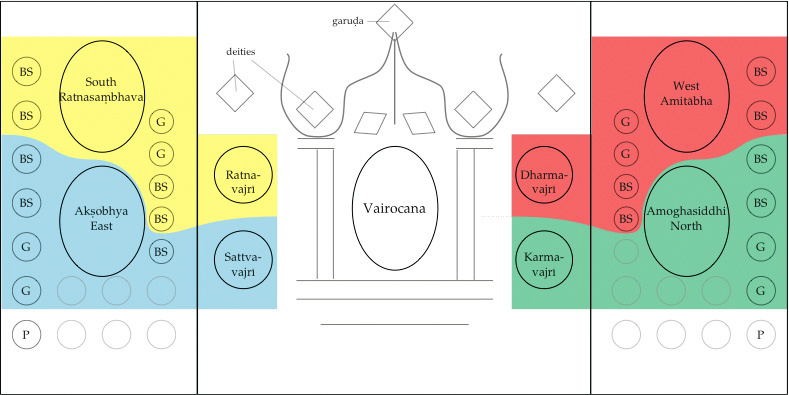
Sculptural configuration in the niche of the Alchi Main Temple.
Alchi Pages
Alchi Picture Galleries
A Curious Restoration
Clay sculptures are notoriously difficult to assess, as they are often restored. This is also true of those in the apse of the Dukhang at Alchi. While it is not surprising that images become illegible in this way, the restoration of the Buddha Amitābha at Alchi raises the question of whether this could have been done under the guidance of educated monks. Rather than performing the usual meditation gesture, the restored left arm of the Buddha is turned towards the viewer, with the palm still horizontal.
An Early Kanjur Temple
A survey of the architecture of the Alchi monastic complex, undertaken in cooperation with a TU-Graz team led by Holger Neuwirth, not only revealed a more refined chronology of the buildings comprising the Main Temple’s complex but also the existence of an early tower-like structure to house the Buddha's teachings.
With the exception of the painted borders, the valance at the top, and the lozenge band at the bottom, the main wall is empty. In addition, the wall has been covered with bright brown paint that extends onto the side walls. This central void, once used to house books, is surrounded by teaching scenes of varying sizes. Stylistically, the damaged murals fall between the Dukhang and the early thirteenth-century paintings of the Sumtsek, with some elements, such as the depictions of the Buddha, closer to the latter.